 20 Years. 450,000+ Games Analyzed. The definitive research report on the evolution of correspondence and daily chess is now live.


Dear LSS Community,
Daily chess—often still affectionately known as correspondence chess—is a game of fierce intellectual battles. For weeks, sometimes months or even years, we test each other’s limits, calculating deep lines and fighting for every fractional advantage on the board. But what makes the Lechenicher Schachserver (LSS Daily) truly special is what happens after the kings are laid down. The battles may be severe, but at our core, we are a global community of chess friends.
To celebrate this spirit, we are thrilled to announce a new, recurring feature on the LSS Daily Blog: Finished Tournament Highlights.
Because of the sheer volume of games played on our platform, we cannot provide a deep-dive analysis of every single event. Instead, every few weeks, we will curate the stories, games, and statistical anomalies that simply struck us the most. Importantly, this series will not focus solely on the highest-rated master events. A beautifully executed strategy in a lower-tier bracket is just as important to us as a clash between Masters.
And of course: we are a community platform. Which means that we always welcome creative efforts by our members. Meaning that when you write about a tournament you participated in (or a great game in such an event), that we – as editors – will then be more than happy to share it for you with other members of the community via either our blog, our LinkedIn page, our Facebook profile page and group, or all of them combined!
Without further ado, let’s dive into our very first edition, covering the standout tournaments that concluded in July 2026.
The “No-Draw” Phenomenon: Tournament RZ-00069
In our recent 20 Years of LSS Research Report, we noted a steady increase in the number of draws across the server, particularly in the higher echelons. As players improve and analytical tools advance, draw rates naturally climb. We noted that faster time controls and Chess960 are effective defense mechanisms against this trend.
However, what happened in Tournament RZ-00069 (10 days base plus 1 day per move) is still incredibly rare: a 0.0% draw rate.
Not a single player let their opponent off the hook. Every single game ended in a decisive victory—a refreshing, uncompromising battlefield where even the lowest-ranked players secured at least one win. The tournament ended in a massive four-way tie for first place, with four players scoring 4 out of 6 points. The ultimate crown went to Jozef Pauk (GER), a loyal LSS member since 2009! Jozef clinched the win based on superior Sonnenborn-Berger tiebreak points, logging a performance nearly 200 points above his own rating. Congratulations, Jozef!
Theoretical Fireworks: The Trompovsky Attack (T474-A45)
Another fascinating event was our Thematic Tournament featuring a highly spectacular and double-edged variation of the Trompovsky Attack: 1. d4 Nf6 2. Bg5 Ne4 3. Bh4 g5 4. f3 gxh4 5. fxe4
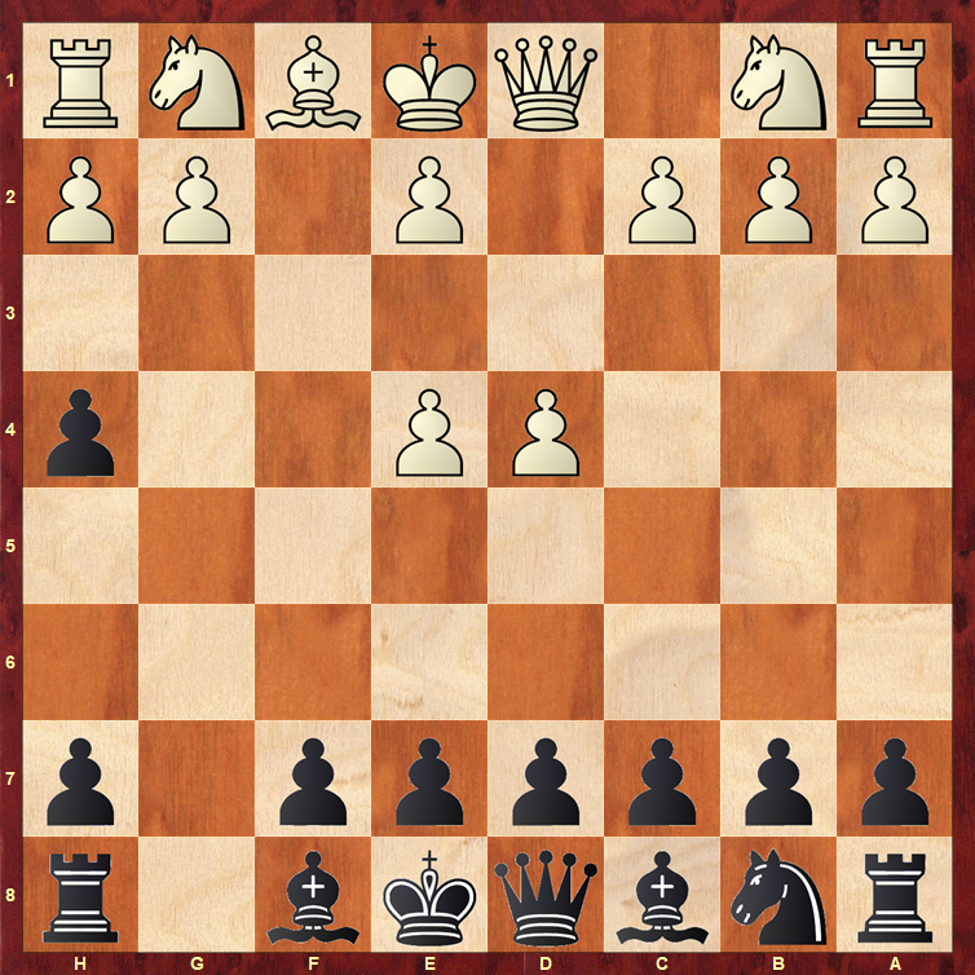
When you force players down such a wild, asymmetrical opening path, fireworks are guaranteed. The winner of the tournament was Sylwia Kolanek from Poland, who boasts a formidable rating of 2159. We are always thrilled to see our strong female community members and younger players take the crown. Congrats, Sylwia!
What made this tournament truly remarkable was the statistical outcome. In a game where White traditionally holds the first-mover advantage, this specific, aggressive thematic line yielded more wins for Black (8 games) than for White (7 games). It serves as a fantastic reminder that deeply analyzing unbalanced positions can completely flip the statistical script.
And it is therefore not a surprise that lots of strong masters and grandmasters use daily or correspondence chess – either directly via their own games, or indirectly via a thorough screening of our databases – to get inspiration for OTB games in official FIDE tournaments.
The Arena Bloodbath & A Somber Farewell: Arena Open AO-00034
Arena Tournaments are massive events, and AO-00034 was no exception, featuring 307 games from over 30 players spanning from October 2024 to July 2026.
A unique aspect of our Arena Tournaments is the 3-1-0 scoring system (3 points for a win,1 for a draw, 0 for a loss). This deviation from classical scoring heavily incentivizes active, aggressive play. The results speak for themselves: 210 out of 307 games ended in a victory, an astonishing decisive rate of 68.4%. Compare that to the close to 95% draw rates that we regularly see in standard correspondence chess games at the highest level!
The winner was Werner Wittal (GER) with a total of 58 points. ICCF IM Frank Bendig (GER) also scored 58 points but required more games to do so, taking second place, while Pablo Varas (CHI) took bronze with 56 points.
A Note of Remembrance: During this tournament, our chess friend Joseph Polanik (USA) passed away. An active player with a 2054 rating, he will be deeply missed by the LSS community. Our thoughts are with his loved ones.
Blitz Knockouts & Penalty Shootouts: BO-00106
Finally, we look at the classical KnockOut Formula. Tournament BO-00106 featured a Blitz time control (10 days base time + 1 day per 10 moves). In a knockout format, draws can be problematic, but our tie-break rules (and random decisions if necessary) give these events the thrilling, high-stakes feel of a World Cup Football penalty shootout.
Out of 15 matches, 5 ended in a decision (33.3%). In the semi-finals, Alexander Marciz (RUS) drew against Lelio Laudati (ITA), with Laudati winning the tiebreak. The other semi-final saw Ian Chester (UK) advance after Ulises Pineda lost on time. In a tense final, Ian Chester emerged victorious after a draw against Laudati. Congratulations to Ian on surviving the gauntlet!
Looking Ahead Keep playing hard, keep analyzing deeply, and above all, keep enjoying the camaraderie that makes this platform home. We will be back soon with our next update, which will include a full report on the recently finished LSS Cup 13.
Best regards,
Ortwin Paetzold & Erik van Dijk
The LSS Leadership Team